 how-to
How to Source Sustainable Supplement Pouches: 2026 Guide
Table of Contents
- Why Sustainable Supplement Pouches Matter for Your Brand
- Pouch Formats and Materials: Stand-Up, Resealable, and Mono-Material Options
- How Supplement Pouch Barrier Properties Protect Freshness and Shelf Life
- Recyclable Packaging for Supplements: What Actually Gets Recycled
- Packaging Sustainability Certifications to Ask For
- How to Vet Sustainable Packaging Suppliers: A Step-by-Step Checklist
- Total Cost and Order Economics for Sustainable Supplement Pouches
- Conclusion
- Frequently Asked Questions
Last Updated: October 19, 2026
Why Sustainable Supplement Pouches Matter for Your Brand
Sustainable supplement pouches are flexible packaging formats made with recycled, recyclable, or lower-impact materials that protect a product while cutting waste.
Here is the tension most brands miss. Your packaging is the first thing a customer touches and the last thing they throw away.
At Hydrate Heroes, we sell a powder that has to stay dry, flow freely, and survive a gym bag.
The market is moving. Many buyers now scan a label for recycling cues before they buy.
Pouch Formats and Materials: Stand-Up, Resealable, and Mono-Material Options
The best format for most supplement brands is a stand-up pouch with a resealable zipper closure. It stands on shelf, reseals after opening, and uses less material than a rigid bottle or jar.
Format choice comes down to how the product is used. Here is how the main options compare.
| Format | Best For | Material Use | Resealable |
|---|---|---|---|
| Stand-up pouch | Powders, capsules, vitamins | Low | Yes, with zipper |
| Flat pouch | Single servings, samples | Lowest | Usually no |
| Paperboard bottle | Shelf presence, capsules | Higher | With cap |
| Rigid jar | Premium positioning | Highest | With lid |
| Box | Kits, multi-packs | Medium | No |
Material choice is the harder call. You will see four families on supplier spec sheets:
- Recycled plastic: includes post-consumer recycled material, which cuts demand for new plastic.
- Mono-material: one plastic type, which makes recyclable packaging far easier to achieve.
- Compostable packaging: breaks down in industrial composting, not a home bin.
- Biodegradable packaging: a broad claim that means little without a standard behind it.
Mono-material structures are the practical winner for recyclability. Mixed laminates, the old default, bond different plastics together. They protect well but are hard to separate, so recyclers often reject them.
How Supplement Pouch Barrier Properties Protect Freshness and Shelf Life
Barrier properties decide whether your powder stays fresh.
For powders and capsules, moisture is the enemy. Clumping, caking, and loss of potency all trace back to water vapor getting through.
Ask suppliers for these specs in writing:
- Water vapor transmission rate: lower is better for powders.
- Oxygen transmission rate: lower is better for sensitive ingredients.
- Seal integrity: tested seals prevent leaks and spoilage.
- High-barrier film structure: the layer build that delivers the numbers.
A common mistake is trading barrier for recyclability without testing. A mono-material pouch may have a weaker moisture barrier than a foil laminate.
Test before you commit. Run accelerated shelf-life checks on filled pouches, not empty ones. Seal integrity testing catches weak seams that only show up after filling and shipping.
Recyclable Packaging for Supplements: What Actually Gets Recycled
Most flexible pouches do not get recycled in curbside programs today. That gap between the label and the bin is where brands lose credibility.
Store drop-off programs accept some polyethylene films (Are you recycling your bag full of bags? You should be!).
So what should a brand do? The Federal Trade Commission's Green Guides set the rules for environmental marketing claims, and vague recyclability claims are exactly what they target.
End-of-life claims should match real-world disposal. If your pouch needs a store drop-off, print that. If it needs industrial composting, say so. Customers forgive honest limits.
Packaging Sustainability Certifications to Ask For
The certifications worth asking for are the ones a supplier can document, not the ones on a sales slide. The gap in most sourcing guides is that they say "ask for certifications" without naming which standard applies to which material, who issues it, and what the certificate actually proves. Here is the specific map.
Match the certification to the material and the claim you intend to make:
| Claim You Want to Make | Certification to Request | What It Actually Verifies |
|---|---|---|
| "Made with post-consumer recycled content" | Recycled content certification (for example, SCS Recycled Content or a similar third-party auditor) | The percentage of pre- and post-consumer recycled material in the specific structure, verified against production records |
| "Packaging is compostable" | Compostability certification to ASTM D6400 (industrial) or a recognized home-compost standard where one applies | That the finished pouch meets the pass/fail criteria for disintegration, biodegradation, and ecotoxicity in a defined composting environment |
| "Paper components come from responsible forests" | Forest sourcing certification such as FSC chain-of-custody | That fiber in the paperboard or paper layer traces to certified, responsibly managed sources through the supply chain |
| "Supplier meets labor and environmental commitments" | A signed supplier code of conduct, ideally backed by a third-party social audit | Commitments and, where audited, verified practices, not a product claim |
A few mechanics matter more than the logo:
- Ask for the certificate number and the issuing body, then verify it. Most certifying bodies publish a certificate lookup. A supplier who cannot produce a verifiable number is telling you something.
- Confirm the certificate covers the exact material and facility you are buying from. A certificate for one product line does not transfer to a different structure or plant.
- Check the scope and expiry. Certifications have defined scopes and renewal dates; an expired or out-of-scope certificate is not evidence.
- Separate product certifications from company certifications. A recycled-content certificate speaks to a material; a code of conduct speaks to a supplier's operations. Do not let one stand in for the other.
For environmental marketing claims built on these certifications, the Federal Trade Commission's Green Guides set the expectations for substantiation, so keep the certificate on file to back any claim you print.
How to Vet Sustainable Packaging Suppliers: A Step-by-Step Checklist
Vetting a sustainable packaging supplier means scoring them on documentation, testing, and total cost, not just the sample. Use this checklist before you sign anything.
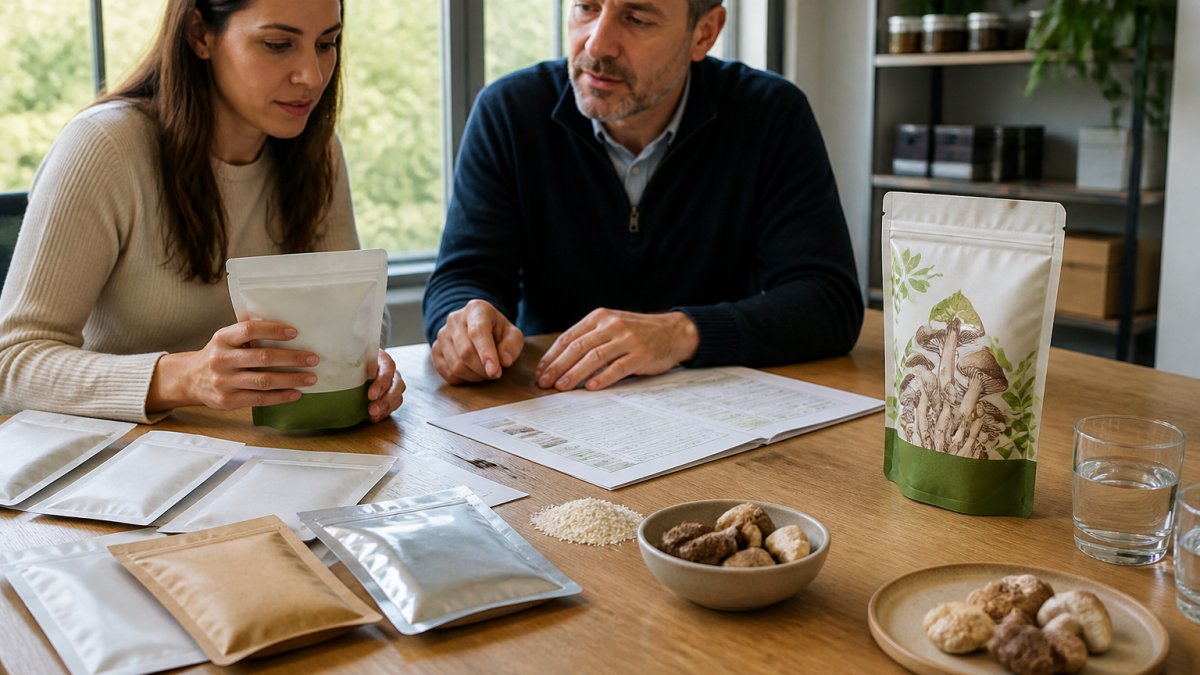
Work through these steps in order:
- Define your spec first. Write down format, material, barrier targets, fill weight, and closure type.
- Request a material data sheet. Confirm the exact structure and recycled content.
- Ask for barrier test results. Get water vapor and oxygen transmission numbers on the finished pouch.
- Request certifications. Get certificate numbers and issuing bodies.
- Order samples and fill them. Test with your actual product, not water.
- Run a seal integrity check. Look for weak seams after filling and shipping simulation.
- Confirm minimum order quantity. Match it to your real volume.
- Get unit cost in writing. Include printing, tooling, and freight.
- Ask about end-of-life guidance. Confirm what disposal instructions the supplier supports.
- Check references. Ask for brands using the same structure at similar volume.
This supplier-vetting checklist doubles as your RFQ template. Send it to three suppliers and compare answers side by side. The gaps in their responses tell you more than the samples do.
Total Cost and Order Economics for Sustainable Supplement Pouches
Total cost, not unit price, decides whether sustainable packaging is affordable. Most sourcing guides stop at "compare landed cost" without showing how the pieces interact.
Build your cost model around these inputs, and understand how each one behaves:
- Unit cost: the per-pouch price at your order quantity. It falls as volume rises because fixed costs spread across more units.
- Minimum order quantity (MOQ): small runs raise unit cost because setup and tooling are divided across fewer pouches. A high MOQ can lock up cash in inventory you may not turn quickly.
- Tooling and printing setup: one-time charges, plates, cylinders, or digital setup, that spread across the run. The same setup charge is a large per-unit cost on a small run and a small one on a large run.
- Freight and duties: real line items that scale with weight and volume. Lighter pouches can reduce shipping weight, which is one place material efficiency shows up in the math.
- Waste and spoilage: failed seals, returns, and damaged units often cost more than the material itself, so a cheaper pouch that fails more is not cheaper.
- Material efficiency: lighter, mono-material structures use less material per unit, which can offset a higher per-pound material price.
How the mechanics actually play out:
- Spread the fixed costs first. Add tooling and setup to the order, then divide by the number of pouches. This is your true per-unit cost before material and freight.
- Compare at the same volume. A unit price quoted at a low MOQ is not comparable to one quoted at a high MOQ. Normalize both to the volume you will actually order.
- Add freight and duties to get landed cost. Then add an allowance for waste and spoilage based on your test results, not a guess.
- Model the inventory cost of a high MOQ. Cash tied up in pouches you will not use for months is a real cost, even if it does not appear on the quote.
Recycled and mono-material structures often cost more per pouch than a standard laminate at low volume. That premium can shrink at higher volumes as fixed costs spread.
Pricing depends on quantity, material, and print complexity, so we do not quote numbers here.
Conclusion
Sourcing sustainable supplement pouches is a chain of small, verifiable decisions: the right format, a tested barrier, honest end-of-life claims, real certifications, and a supplier who answers hard questions in writing.
The hard part is not finding a pouch. It is finding one that protects your product and holds up to a customer's scrutiny.
At Hydrate Heroes, we built our powder around a clean formula with six functional mushrooms, Balanced 88 Gold Sodium™, zero sugar, and no sucralose or erythritol.
Frequently Asked Questions
What makes a supplement pouch sustainable?
A sustainable supplement pouch combines material efficiency with a credible end-of-life path. That usually means mono-material or high-recycled-content film, a resealable zipper closure, and a barrier layer that protects the powder without excess packaging. Look for third-party certifications such as How2Recycle or FSC, and ask the supplier for recycled-content percentages and disposal instructions. Sustainability is not one attribute; it is the combination of material, barrier performance, and what happens to the pouch after use.
What barrier properties should supplement pouches have?
Supplement pouch barrier properties should match the product. Powders and capsules are sensitive to moisture and oxygen, so ask for moisture vapor transmission rate (MVTR) and oxygen transmission rate (OTR) data. A high-barrier film with a metallized or EVOH layer is common. Also check seal integrity and zipper closure performance after repeated opening. Request test reports rather than marketing claims, and run your own shelf-life trial before committing to a full production run.
How can I verify a packaging supplier's sustainability claims?
Ask for documentation, not adjectives. Request certificates for recycled content, chain-of-custody records, and any packaging sustainability certifications the supplier holds. Confirm food-contact compliance and request a sample for third-party lab testing. Ask where the film is extruded and printed, and whether the supplier can provide a letter of guarantee. A supplier that cannot produce paperwork for its claims is a risk. Build verification into your RFQ so every quote is compared on the same evidence.
Are recyclable pouches better than compostable pouches?
It depends on where the pouch will be disposed of. Recyclable packaging for supplements works only if a local program accepts the material, so check How2Recycle labeling and your target market's curbside rules. Compostable pouches need industrial composting facilities, which most households cannot access. For many supplement brands, a mono-material recyclable pouch with clear disposal instructions is the more honest choice. Avoid biodegradable claims unless you can substantiate them with a recognized standard.