 how-to
How to Calculate Your Personal Sweat Rate
Table of Contents
- Why Knowing Your Sweat Rate Changes Your Hydration
- The Sweat Rate Calculation Formula Explained
- How to Calculate Fluid Loss During Exercise: Step-by-Step
- Factors That Change Your Sweat Rate
- Electrolyte Replacement Guidelines for Different Sweat Rates
- Common Mistakes When Measuring Sweat Rate
- Frequently Asked Questions
Last Updated: September 16, 2026
Why Knowing Your Sweat Rate Changes Your Hydration
Most athletes drink by feel, and most athletes get it wrong. Learning how to calculate your personal sweat rate turns hydration from guesswork into a measurable variable, and it takes about an hour to figure out. This guide from Hydrate Heroes walks through the formula, the measurement, and what to do with the number once you have it.
The Sweat Rate Calculation Formula Explained
The sweat rate calculation formula is simple arithmetic: body mass lost during exercise, plus fluid consumed, divided by exercise duration in hours. Everything else is just care with the inputs.
The Core Equation
Sweat rate (L/hr) = (Pre-exercise weight − Post-exercise weight + Fluid intake − Urine volume) ÷ Exercise duration in hours
What Each Variable Means
- Pre-exercise weight: your body mass immediately before training, ideally after using the bathroom
- Post-exercise weight: your body mass immediately after, before you drink anything or change clothes
- Fluid intake: everything you drank during the session, measured in a marked bottle
- Urine volume: any bathroom output during the session, which most people can estimate as zero for sessions under an hour
- Exercise duration: total time in hours, so 90 minutes becomes 1.5
A common mistake is weighing yourself in sweaty clothes both times. That inflates the post-exercise number and hides fluid loss.
How to Calculate Fluid Loss During Exercise: Step-by-Step
To calculate fluid loss during exercise accurately, you need a scale, a measured bottle, and a session that resembles your real training. The whole protocol takes one workout.
What You'll Need Before You Start
- A digital scale accurate to 0.1 kg (0.2 lb), placed on a hard, level floor
- A water bottle with volume markings
- A towel and a dry change of clothes
- A notebook or phone for recording weights
- A session of at least 60 minutes at realistic intensity
Scale accuracy matters more than people expect. A bathroom scale that drifts by half a kilogram will distort an hourly sweat rate by roughly half a liter.
The Measurement Walkthrough
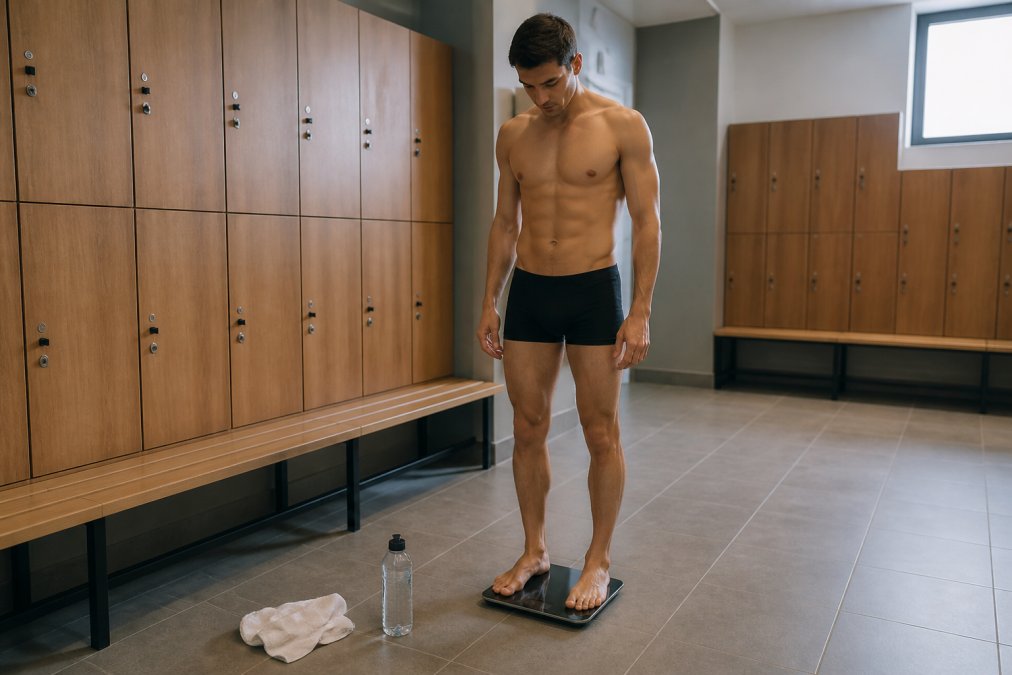
- Empty your bladder, then weigh yourself in minimal, dry clothing. Record it.
- Train as normal for at least 60 minutes. Drink only from your measured bottle.
- Record exactly how much you drank.
- Towel off, change into dry clothes, and weigh again immediately.
- Subtract post-exercise weight from pre-exercise weight, add fluid intake, subtract any urine output.
- Divide by duration in hours.
Factors That Change Your Sweat Rate
Your sweat rate is not a fixed personal constant. It moves with conditions, and a number measured in a cool gym will mislead you on a hot road. The sections below quantify the biggest levers so you can adjust a baseline measurement instead of re-testing from scratch every time conditions change.
Exercise Intensity
Intensity is the largest single lever. Working at a higher percentage of your metabolic rate generates more heat, and sweating is the body's primary thermoregulation mechanism for shedding it. As a rough pattern, moving from an easy conversational pace to a hard race effort can roughly double hourly sweat output for the same athlete in the same conditions.
Temperature and Humidity: The Heat Index Adjustment
Ambient temperature and relative humidity change how much of your sweat actually evaporates. In high humidity, sweat drips off instead of cooling you, so you produce more of it for the same workload. The National Weather Service heat index is the practical way to think about this: it combines temperature and relative humidity into a single "feels like" number, and that number tracks sweat loss better than temperature alone.
A workable adjustment model:
- Below about 60°F with low humidity: use your baseline rate as measured.
- 60-75°F, moderate humidity: multiply your baseline by roughly 1.1 to 1.2.
- 75-85°F, or a heat index in the 80s: multiply by roughly 1.2 to 1.4.
- Heat index above 90°F: multiply by 1.4 or more, and re-test rather than trusting the math.
Altitude
Altitude adds a second, less obvious shift. At higher elevation the air is drier and you breathe faster and deeper, which increases respiratory water loss on top of sweat. Many athletes also drink less because they do not feel as hot in thinner, cooler air, which widens the deficit.
Fitness and Acclimatization
Trained, heat-acclimated athletes typically begin sweating sooner and at a higher rate, but their sweat tends to carry a lower sodium concentration. Acclimatization takes roughly one to two weeks of repeated heat exposure. During that window your sweat rate can climb while your sodium losses per liter fall, which is why a rate measured on day one of a heat wave is not the rate you will have on day ten.
Body Size and Genetics
Larger bodies generate more heat, and the density and output of your sweat glands is partly inherited. Two athletes of the same weight can differ by 0.5 L/hr or more at identical intensity in identical conditions. This is the main reason generic hydration tables fail.
Clothing and Equipment
Clothing traps heat and blocks evaporation. A waterproof shell can raise your effective sweat rate well above what the same effort produces in a singlet. Helmets, pads, and heavy packs add the same effect. If your sport requires gear you cannot remove, test in that gear, not in shorts and a t-shirt.
Electrolyte Replacement Guidelines for Different Sweat Rates
Once you have a number, the next question is what to put back. Electrolyte replacement scales with sweat volume, not with a fixed rule. The more you sweat, the more sodium you lose, and sodium is the electrolyte that matters most for fluid balance. This section turns your calculated rate into a drink plan.
Start With Sodium, Not Sugar
Sweat is mostly water but carries meaningful sodium, plus smaller amounts of potassium, magnesium, and chloride. Sodium is the electrolyte most tied to fluid balance and cramping risk, so it should drive your choice. A typical sports drink lands in the range of roughly 300-500 mg of sodium per 12 oz serving.
Bracket Your Losses by Sweat Volume
| Hourly Sweat Rate | Typical Session Loss | Electrolyte Priority | Practical Approach |
|---|---|---|---|
| Under 0.5 L/hr | Low | Maintenance only | Water plus normal meals |
| 0.5-1.0 L/hr | Moderate | Sodium with fluid | One electrolyte serving per hour |
| 1.0-1.5 L/hr | High | Sodium and potassium | Electrolyte serving every 45 minutes |
| Over 1.5 L/hr | Very high | Aggressive sodium | Planned schedule, not thirst |
Visible white streaks on dark clothing after a session are a useful signal that your sodium concentration runs high. So is a salty taste on your skin. Both suggest you should aim toward the upper end of the sodium range for your bracket.
Water vs. Electrolyte: When Each Wins
The right drink depends on session length and your calculated loss, not on habit.
- Under 60 minutes, low sweat rate: plain water is fine. You will replace the sodium with your next meal.
- 60-90 minutes, moderate to high sweat rate: water plus an electrolyte serving per hour. Drinking plain water at high volume without sodium can dilute blood sodium, a real risk for slower athletes in the heat.
- Over 90 minutes, high sweat rate: a planned schedule with sodium at every aid station. Do not wait for thirst; by the time you feel thirsty you are already behind.
- Multi-hour events: alternate electrolyte and plain water, and pair with solid food or a carb source once the session passes roughly two hours.
How Much to Drink Per Hour
A practical starting point is to replace roughly 50-70% of your hourly sweat loss during exercise, then top up after. If your rate is 1.2 L/hr, aim for about 0.6-0.8 L/hr of fluid during the session, with sodium built in. Drinking to fully replace losses during exercise is a common mistake and can leave you sloshy and uncomfortable.
After the Session
This is where formula choice matters. Many conventional powders lean on sugar and artificial sweeteners to carry the sodium. Hydrate Heroes offers a revolutionary approach to hydration with the only powder on the market that combines six functional mushrooms with premium electrolytes. Designed as The Healthy Alternative®, our plant-based formula provides essential replenishment with zero sugar and only five calories per serving. We prioritize your wellness by utilizing our proprietary Balanced 88 Gold Sodium™ while strictly excluding sucralose and erythritol. Experience a cleaner, more effective way to stay hydrated and energized throughout your day.
Common Mistakes When Measuring Sweat Rate
The most common error is measuring fluid intake by guesswork. If you did not drink from a marked bottle, you do not have a number, and the formula collapses.
Other frequent problems:
- Weighing in wet clothing both times, which cancels out much of the fluid loss
- Using a session shorter than 60 minutes, where scale error dominates the result
- Testing at easy pace, then applying the number to race pace
- Ignoring urine output on long sessions, which understates true loss
- Treating one test as permanent rather than rechecking each season
Frequently Asked Questions
What is a healthy sweat rate per hour?
A typical sweat rate falls between 0.5 and 2.0 liters per hour, but this varies widely based on body size, exercise intensity, and ambient temperature. Highly trained athletes in hot conditions can lose over 2.5 liters per hour. Your personal sweat rate matters more than any average. Once you know your number, you can match fluid intake to actual losses instead of guessing. If your rate consistently exceeds 2 liters per hour, pay close attention to electrolyte replacement, especially sodium.
How can I measure my sweat rate at home?
You can measure it at home with a scale, a towel, and a measured water bottle. Weigh yourself nude before exercise, record how much you drink in milliliters during the session, then weigh yourself nude again afterward. Subtract post-exercise weight from pre-exercise weight, add fluid intake, and divide by exercise duration in hours. A bathroom scale accurate to 0.1 kilograms gives reliable results. Repeat the test across different conditions to see how your personal sweat rate shifts.
Does sweat rate change based on environmental conditions?
Yes, significantly. Ambient temperature, relative humidity, and sun exposure all raise sweat volume because your body works harder to regulate core temperature. A run that produces 1 liter per hour in cool, dry weather can produce 1.8 liters per hour in hot, humid conditions. Wind and indoor ventilation also affect evaporation, which changes how much you actually lose. Test your sweat rate in the conditions you train in most, then adjust upward for hotter or more humid days.
How do I use my sweat rate to plan electrolyte replacement?
Once you know your hourly sweat rate, multiply it by the sodium concentration of your sweat, which averages 500 to 1,500 milligrams per liter. That gives you a target sodium range for each hour of exercise. For a 1-liter-per-hour sweat rate, you need roughly 500 to 1,500 milligrams of sodium per hour. Choose an electrolyte powder that matches your range without added sugar. Hydrate Heroes prioritizes your wellness by utilizing our proprietary Balanced 88 Gold Sodium™ while strictly excluding sucralose and erythritol.
Knowing your sweat rate is the difference between a hydration plan and a hope. Hydrate Heroes was built for the second half of that equation, with a plant-based formula that pairs six functional mushrooms and Balanced 88 Gold Sodium™ with zero sugar, no sucralose or erythritol, and just five calories per serving. Once you have your number, get started with Hydrate Heroes and give your rehydration strategy an electrolyte source that matches how you actually train.