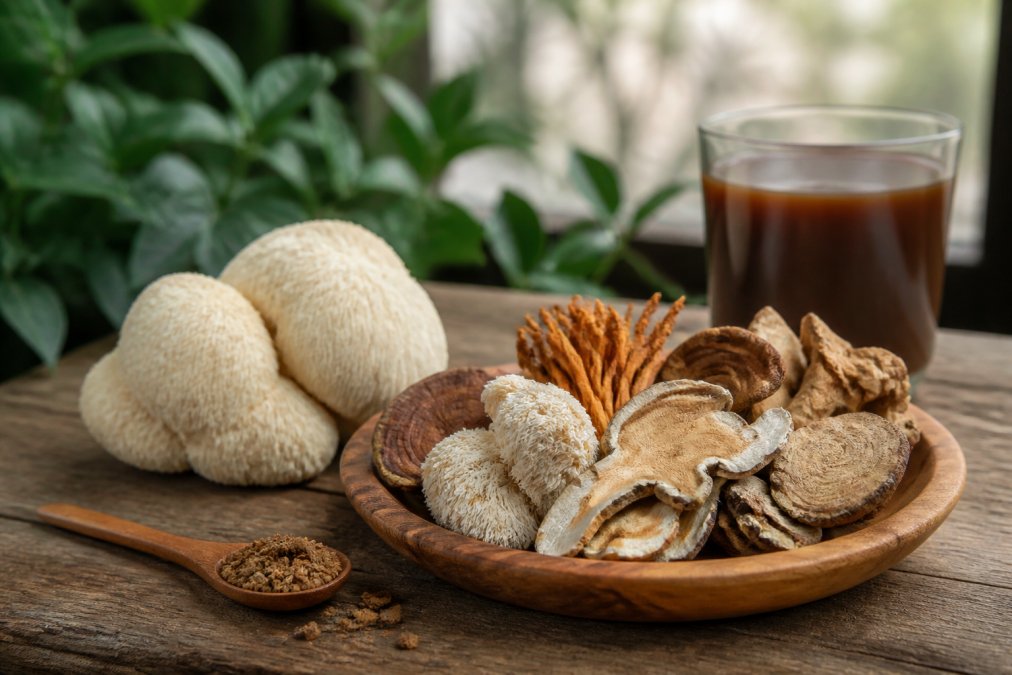
 ultimate-guide
Benefits of Functional Mushrooms for Daily Energy
Table of Contents
- What Are Functional Mushrooms and How Do They Support Daily Energy?
- Cordyceps Benefits for Energy: The Stamina Mushroom
- Functional Mushrooms vs Caffeine for Energy: Which Gives Better Stamina?
- How to Incorporate Functional Mushrooms into Your Routine
- Bioavailability and Extraction: Why Some Mushroom Powders Don't Work
- Safety, Side Effects, and Drug Interactions to Know Before You Start
- Frequently Asked Questions
Last Updated: September 24, 2026
What Are Functional Mushrooms and How Do They Support Daily Energy?
Functional mushrooms are fungi consumed for specific health outcomes rather than nutrition alone, and they support daily energy by influencing how your body manages stress, oxygen use, and cellular repair. At Hydrate Heroes, our electrolyte powder combines six functional mushrooms with premium electrolytes because the research on adaptogenic fungi keeps pointing in the same direction: they work on the systems that make energy last, not just the feeling of being awake.
The distinction matters. A mushroom is functional when its bioactive compounds, primarily beta-glucans and polysaccharides, produce a measurable effect on immune modulation, cognitive performance, or stress resilience. Unlike caffeine, which borrows energy from later in your day, these compounds support the metabolic machinery that produces energy in the first place.
That is the core argument of this guide: functional mushrooms do not stimulate you, they support you. Below, we break down which varieties matter, how to dose them, and where most products fail.
Cordyceps Benefits for Energy: The Stamina Mushroom
Cordyceps benefits for energy center on how the body uses oxygen during physical effort. This fungus has a long history in traditional medicine, and modern interest focuses on its effect on ATP production, the process your cells use to convert fuel into usable energy. Supporting these cellular metabolic pathways often involves integrating complementary antioxidants, such as those found in the benefits of green tea, to maintain sustained vitality throughout the day.
Cordyceps is a genus of parasitic fungi whose bioactive compounds are studied for their effect on oxygen use and physical stamina. Unlike a stimulant, cordyceps does not raise your heart rate or mask fatigue. It supports the underlying systems, which is why athletes and endurance-focused users gravitate toward it.
How Cordyceps Works Without a Caffeine Crash
Caffeine works by blocking adenosine receptors, the signal that tells your brain it is tired. That is why the energy feels borrowed; when the caffeine clears, the accumulated adenosine hits at once. Cordyceps takes a different path. It supports mitochondrial function and oxygen uptake, so the energy you feel tracks your actual capacity rather than a chemical override.
In practice, this means a slower onset and a longer, flatter curve. You will not feel a jolt. What some users notice is steadier output through the afternoon, without the 3 p.m. collapse that follows a second coffee.
Functional Mushrooms vs Caffeine for Energy: Which Gives Better Stamina?
Functional mushrooms vs caffeine for energy comes down to what kind of stamina you need, and the two work through completely different pathways. Caffeine is an adenosine receptor antagonist: it blocks the signal that tells your brain it is tired, which is why the energy feels borrowed and why the accumulated adenosine hits at once when it clears. Functional mushrooms do not block anything. Their bioactive compounds, primarily beta-glucans and polysaccharides, support the metabolic systems that produce energy in the first place, including mitochondrial function, oxygen uptake, and the stress response that governs how efficiently your body uses fuel.
That mechanistic difference explains the practical difference. Caffeine delivers a fast, sharp spike that fades within a few hours. Functional mushrooms deliver a gradual, sustained effect that builds with consistent daily use.
| Factor | Caffeine | Functional Mushrooms |
|---|---|---|
| Mechanism | Blocks adenosine receptors | Supports mitochondrial function and oxygen use |
| Onset | 15-45 minutes | Days to weeks of consistent use |
| Duration | 3-5 hours | Sustained across the day |
| Crash | Common as adenosine rebounds | Uncommon |
| Sleep impact | Can disrupt, especially after 2 p.m. | Minimal at typical doses |
| Tolerance | Builds with daily use | No known tolerance effect |
| Best for | Short bursts of focus | All-day stamina and stress resilience |
Caffeine is not the enemy. For a single deadline or an early workout, nothing beats it. But if your goal is energy that holds steady from morning to evening without wrecking your circadian rhythm, mushrooms are the better tool. Many people use both, timing caffeine early and letting mushrooms carry the afternoon.
Why the Crash Happens and Why Mushrooms Don't Cause One
The caffeine crash is not a failure of willpower; it is pharmacology. When caffeine blocks adenosine receptors, adenosine keeps accumulating in the background. Once caffeine is metabolized, usually within three to five hours, all that pent-up adenosine binds at once and produces the familiar slump. Functional mushrooms do not create that rebound because they do not block anything. They support the underlying systems, so the energy you feel tracks your actual capacity rather than a chemical override.
Can You Stack Them?
Yes, and many people do. A common pattern is 100-200 mg of caffeine from coffee or tea in the morning paired with cordyceps or lion's mane, then a second mushroom dose in the early afternoon without additional caffeine. This gives you the immediate lift when you need it and the steady support when the caffeine fades. Keep caffeine before 2 p.m. to protect sleep, and let the mushrooms handle the rest of the day.
How to Incorporate Functional Mushrooms into Your Routine
The easiest way to incorporate functional mushrooms into your routine is to attach them to a habit you already have, usually your morning drink. Consistency beats intensity here; a small daily dose outperforms a large occasional one.

Dosage Guidelines for Daily Energy
Dosage guidelines for daily energy vary by species, and no single number fits everyone. Most practitioners find the following ranges are a reasonable starting point for well-extracted products, adjusted based on how you feel over several weeks:
- Cordyceps: 1-3 grams per day of a concentrated extract, often split into a morning and pre-activity dose. This is the most studied species for physical stamina and oxygen use.
- Lion's mane: 500 mg to 1 gram per day, typically in the morning for cognitive support and focus.
- Reishi: 1-1.5 grams per day, often taken in the evening for its calming effect on the stress response.
- Blends: Follow the label, but check that the total extract weight, not the raw powder weight, matches the ranges above.
Timing Your Dose Around Your Circadian Rhythm
Timing your dose around your circadian rhythm changes how the same product feels, and this is where most guides leave readers guessing. Energizing varieties such as cordyceps work best in the morning or 30-60 minutes before activity, when your cortisol naturally peaks. Calming varieties such as reishi suit the evening, when cortisol should be falling.
A practical daily schedule looks like this:
- Morning (7-9 a.m.): Cordyceps or a cordyceps-lion's mane blend with your coffee or breakfast. This aligns with your natural cortisol peak and supports energy through the morning.
- Early afternoon (1-2 p.m.): A second dose of cordyceps or lion's mane if you need it. Avoid caffeine here to protect sleep.
- Evening (8-10 p.m.): Reishi, if you use it, to support the wind-down phase of your stress response.
Bioavailability and Extraction: Why Some Mushroom Powders Don't Work
Bioavailability and extraction methods explain why two products with identical labels can perform differently. Mushroom cell walls are made of chitin, a tough fiber your digestive system cannot break down on its own. Without proper extraction, much of the active compound passes through you unabsorbed.
Safety, Side Effects, and Drug Interactions to Know Before You Start
- Blood thinners: Reishi and other varieties may affect clotting. Talk to your doctor before combining them with anticoagulants.
- Blood pressure and blood sugar medication: Some mushrooms can lower blood pressure or affect glucose. If you take medication for either, monitor and consult your physician.
- Immune-suppressing drugs: Because these fungi support immune modulation, they may work against immunosuppressants.
- Kidney conditions: Anyone managing kidney function should check with a clinician before adding a concentrated extract.
If you take prescription medication for blood pressure, blood sugar, or clotting, do not start a mushroom regimen without clearing it with your doctor first. The interaction risk is real and easy to miss.
For most healthy adults, side effects are mild, occasionally digestive upset when starting. Begin with a lower dose and increase gradually. Guidance from the National Center for Complementary and Integrative Health reinforces checking with a healthcare provider before adding any supplement, particularly when you already take medication.
Frequently Asked Questions
Can you overdo functional mushrooms?
Yes, high doses can cause digestive upset, headaches, or loose stools. Stick to the serving size on the label. If you take blood thinners, diabetes medication, or immunosuppressants, talk to your doctor first because mushrooms can interact with these drugs. Start with one serving daily and give your body a week to adjust before increasing.
Which mushroom is best for energy?
Cordyceps is the standout for physical stamina and oxygen use during exercise. Lion's mane supports mental clarity and focus, which many people experience as energy. Reishi helps with stress resilience and sleep quality, so you wake up less fatigued. A blend that includes several types covers both physical and mental energy better than a single mushroom.
Is it good to take mushroom supplements every day?
Daily use is how most people get consistent results. Functional mushrooms work gradually by supporting homeostasis, immune modulation, and cortisol regulation rather than delivering an instant jolt. Many people notice steadier energy and mental clarity after two to four weeks of daily use. Cycle off for a week every few months if you prefer, but daily dosing is generally considered safe for healthy adults.
How do functional mushrooms interact with electrolyte balance?
Functional mushrooms do not directly replace sodium, potassium, or magnesium, so they are not a substitute for electrolytes. However, adaptogens like reishi and cordyceps support cortisol regulation and metabolic health, which can help your body manage fluid balance more efficiently. For real hydration during exercise or heat, pair mushrooms with an electrolyte powder that contains sodium and potassium.